How Clay turns 188 agencies into a growth channel
Clay lists 188 agencies in a partner directory with tiers, indexable profiles and a 20% revenue share. Here's how the pieces fit, and when to copy it.

Clay's partner directory listed 188 agencies and consultants on 18 October 2026, all of them in the business of setting up Clay for other companies. Each partner gets a tier, a profile page Google can index, leads from Clay's matchmaking and a share of the revenue on new customers. In return Clay gets people who make a complicated product work inside a customer's business, without hiring them.
The partner program is worth copying only if your product needs setting up. Here's how its pieces fit, from the directory down to the classes that train the next partners.
The partner directory answers the buyer's first question
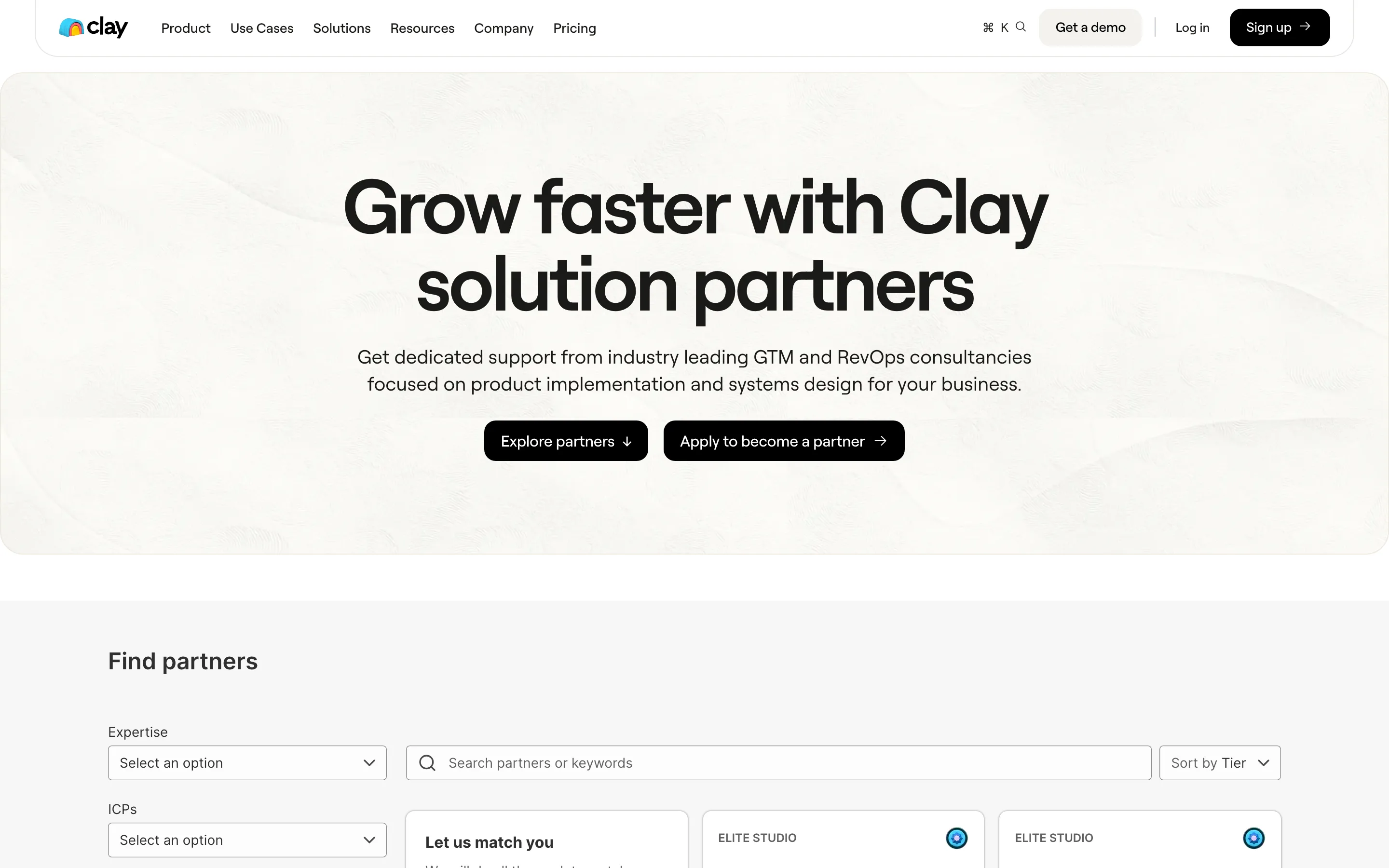
The page opens with "Grow faster with Clay solution partners" and promises support from consultancies "focused on product implementation and systems design for your business." Two buttons sit under it: Explore partners and Apply to become a partner. One page serves both sides of the market.
The filters speak the buyer's language: expertise, ICPs, industry, language, pricing and minimum engagement, sorted by tier. A card in the grid offers matchmaking, "We will do all the work to match you with the best partners." That's the question a buyer asks right before committing to a tool this deep: who will set it up for us? Clay's own partner page calls the directory "one of Clay's most visited surfaces".
Every profile is a landing page
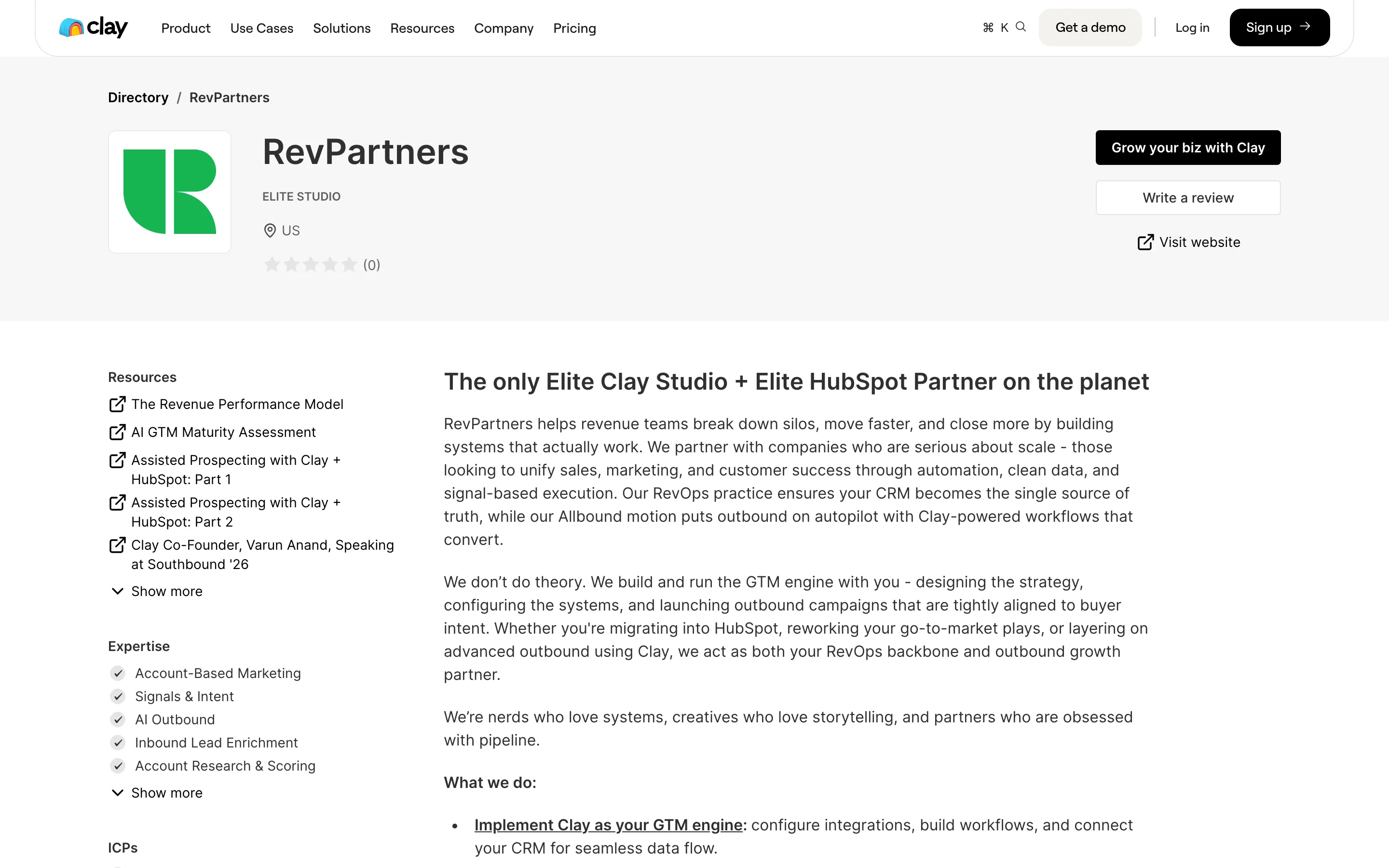
Open a partner and you get a full page. RevPartners shows its tier (Elite Studio), its location, a star rating, a "Grow your biz with Clay" button that leads to its contact form, a list of resources, its expertise, the companies it serves, its industries and languages, a pricing line ("any budget") and a minimum engagement ("3 months"). Below that sit use cases and a reviews section.
Each profile has its own address and title, "RevPartners | Clay Solutions Partner Directory", with a canonical pointing at itself and nothing blocking indexing. That's 188 pages on Clay's domain, with descriptions the partners write themselves, each one a fit for a search that pairs an agency name or a use case with Clay. It's the same logic that lets Zapier run programmatic SEO across 134,000 pages, with the writing done by people who want the lead.
The weak spot shows on the same screen. RevPartners sits in the top tier with zero reviews. Ratings persuade once buyers leave them, and until then the badge carries the trust alone.
Tiers are earned with work, and the money follows
The solutions partner program has four tiers, and each one names its reward. Artisan gets resources to level up. Advanced Artisan gets "network, positioning, and leads". Studio gets co-selling on SMB and mid-market deals. Elite Studio gets "account planning, targeted co-selling, bespoke co-marketing."
Getting in takes four steps: an application, an initial fit review, a showcase of builds and testimonials, then a final decision. Clay reviews applications monthly. On the money side, it says it will share 20% of revenue with partners on new shared customers, and its Partner Growth Fund offers grants from $500 to $15,000 or support in kind. Because the badge is earned with shipped client work, it tells a buyer something when they see it in the directory.
Clay University trains the next partners
Clay University runs courses such as Clay 101: GTM Automation, one-week cohorts led by an instructor, documentation and templates it calls Claybooks. It also links to a page for hiring GTM engineers and a GTM job board. Learn the tool, build with it, get hired or apply to the directory: each step feeds the next.
One step in that chain is on hold right now. The certification program is "under construction", with new submissions paused while Clay builds the next version, and existing certifications still stand. The application asks for any certifications you hold, so for now the showcase of real work carries more of the weight.
What to copy, and when to skip it
A partner channel pays off when your product needs a setup project before it delivers: data, integrations, workflows someone has to design. Tools like that create work for consultants, and Clay chose to organize that work around its own directory. If that's your product, three moves carry over:
- One page for both sides. Buyers find a partner, partners find the application, and the filters use the buyer's words: budget, minimum engagement, industry.
- A profile per partner, built to rank. Give every partner an indexable page they'll keep current, with a button that sends the lead straight to them.
- Tiers tied to proof. Rank partners by delivered work and reviews, and pay for the revenue they bring.
If customers succeed with your product alone in an afternoon, skip it. A directory of experts for a simple tool tells buyers it's hard to use. For a product that grows from what users build and share, the closer model is Notion's template gallery.
If you want help working out whether a partner channel fits your product, and building the pages for it, that's the kind of work we do.


