Google says AI search sends billions of clicks. Measure yours.
Google says AI features send billions of clicks a week. Independent data puts ChatGPT referrals at 5.2% of sessions. Here is how to measure your own number.

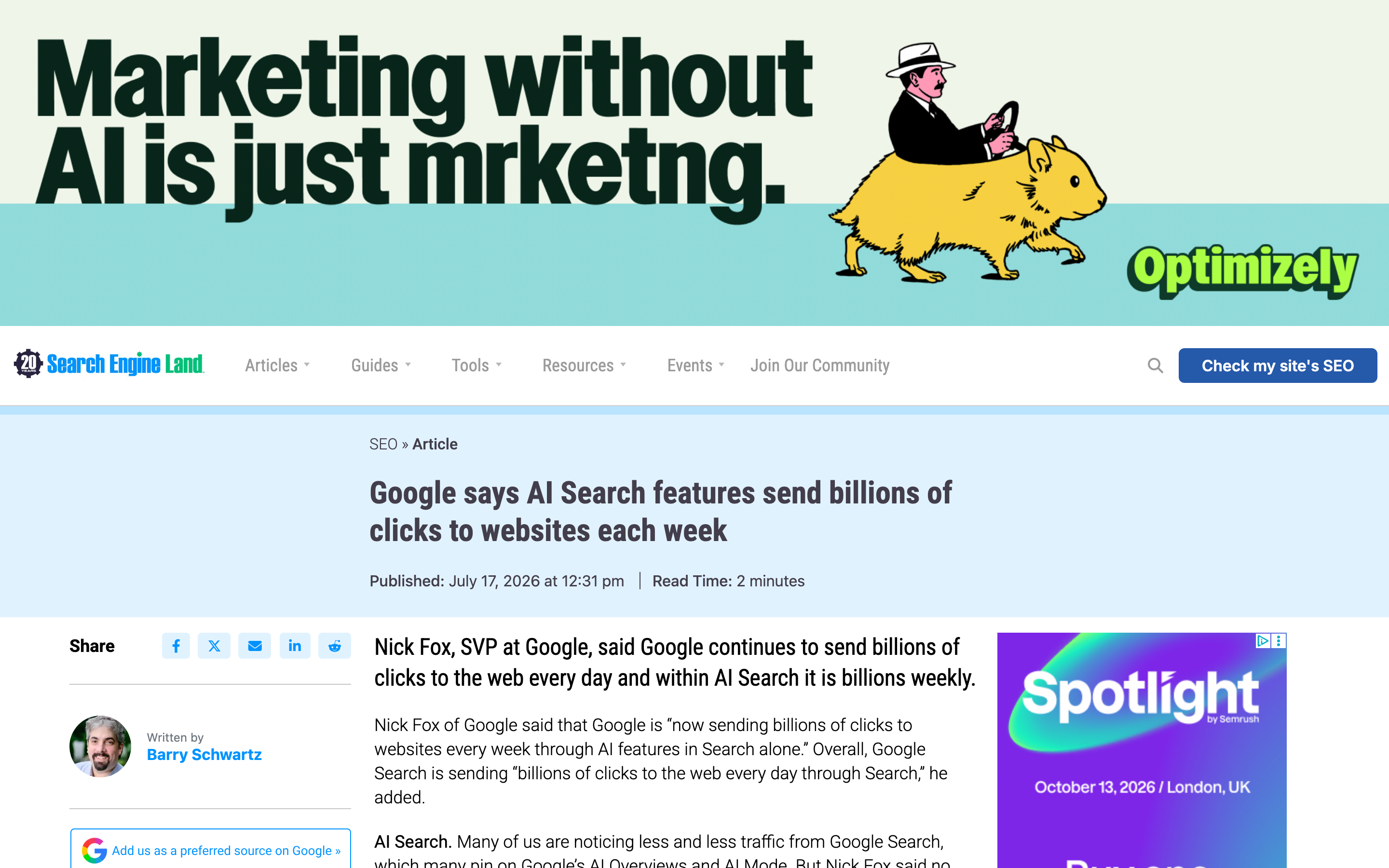
Google's head of Search said on Friday that AI Overviews and AI Mode send billions of clicks to websites every week. He said it on LinkedIn, with no chart, no rate, and no denominator. If you want to know what AI search traffic is doing to your site, the number that answers the question is in your own Search Console, and you can pull a baseline in about twenty minutes.
Two data points landed nine days apart in July and they read like opposites. One is a Google executive's aggregate. The other is a clickstream study of 45,000 households. Both can be true at the same time, which is exactly why neither one is a substitute for your own report.
What Google said, and what it left out
On 17 July, Nick Fox, Google's SVP of Search, wrote that Google is "now sending billions of clicks to websites every week through AI features in Search alone," and that Search overall sends billions of clicks a day. He added that people are using Google Search more than ever now that they can ask whatever is on their minds. Search Engine Land covered the post the same day.
Billions is an absolute count across every site Google indexes. A rate needs two numbers, and Google published one. Clicks per billion impressions could be climbing or falling and that sentence would still be accurate. Google shipped AI performance data inside Search Console this year and still declines to publish platform-level click data, which is the part practitioners keep asking for.
What the research measured instead
On 8 July, three researchers at Bocconi University posted Answering Without Referring: How AI Search Rewrites the Web's Economic Bargain. They used URL-level Comscore desktop clickstream data covering more than 45,000 US households across October 2024 and July 2025, a window that captures the staggered rollout of ChatGPT Search to different user tiers.
Three findings matter for anyone running a content site. ChatGPT produces an outbound click in 5.2% of conversation sessions, well under Google's referral ratio. Wider ChatGPT Search access cut traditional search use by 9.4% on average, deepening to 17.0% after twenty weeks of exposure. And the clicks that do come out skew toward specialized destinations and away from ad-supported sites.
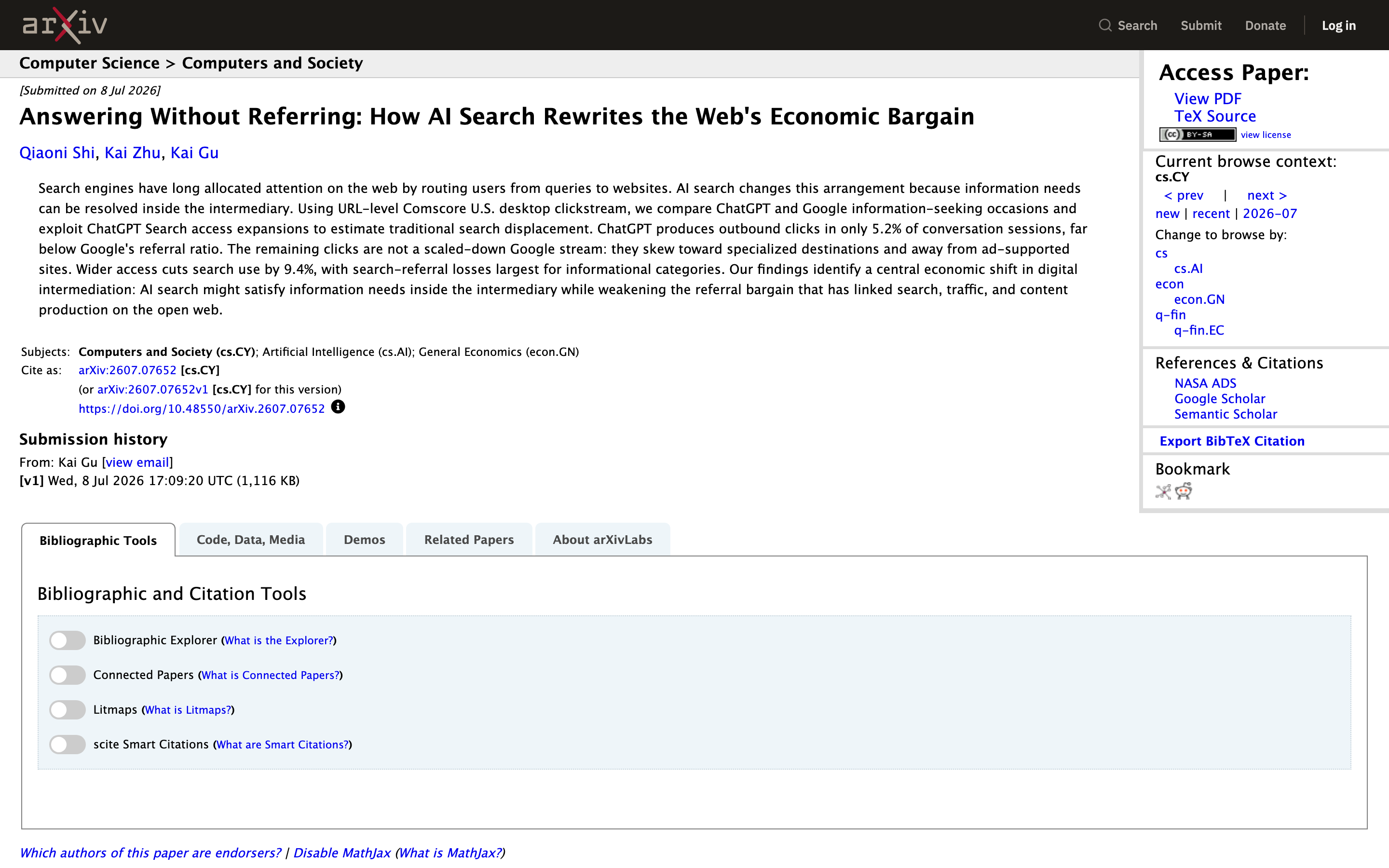
That study measures ChatGPT, not Google. Different surface, different economics. Put the two side by side and you get the shape of the year: absolute click volume can grow while the odds that any single answer sends someone to your page get worse. Your site sits somewhere on that curve, and no industry aggregate will tell you where.
How to measure your AI search traffic this week
Two numbers, two places, one shared doc.
One: the AI surfaces in Search Console. Open the AI performance data and record clicks, impressions and CTR for the last 28 days. Then record the same three figures for classic web search over the identical window. The gap between those two CTRs is your real exposure. We walked through the report in how to read Search Console's AI performance report.
Two: assistant referrals in analytics. Group chatgpt.com, perplexity.ai, copilot.microsoft.com and gemini.google.com into a single channel, then record sessions, conversion rate and revenue for the same 28 days. Most teams still have these scattered across Direct and Referral, which makes the channel look like noise. The setup is in AI referral traffic is now one channel.
Then go one level down. Export your top 20 pages by AI-surface impressions and compare each page's AI CTR against its classic search CTR. Pages where the two sit close are pages the model can't answer on its own. Pages where AI CTR collapses are pages whose answer now fits in a paragraph.
What to do with the two numbers
The page-level split tells you where to put the next quarter of writing. If a page holds its impressions and loses its clicks, the query has been absorbed. Rewriting it deeper rarely brings the clicks back. Moving that budget to pages an answer box can't finish does: pricing, comparisons, calculators, product documentation, anything where the reader has to reach your interface to get what they came for.
The referral number usually surprises B2B teams in the other direction. Assistant sessions arrive in small volume and convert at rates that make organic look sleepy, because the model has already done the shortlisting. A few hundred sessions a month at four times your organic conversion rate is a channel worth naming and funding.
Record both numbers with today's date, then repeat on the same day next month. After three readings you have a trend line built from your own traffic, which beats arguing about someone else's billions.
If you want help turning that baseline into a content plan with a budget attached, that's the work we do.


