Google's goto links made rank tracking data a moving target
Google now routes result links through google.com/goto. Your rankings held, but the completeness of your rank tracking data now changes vendor by vendor.

On 26 August Google confirmed it's routing search result links through google.com/goto. The change costs your rank tracking data something real: every destination URL a tool used to read straight off the results page now takes an extra request to resolve, and how well each vendor keeps up moves week to week. Your rankings are fine. Your September report might not be.
What a goto link is
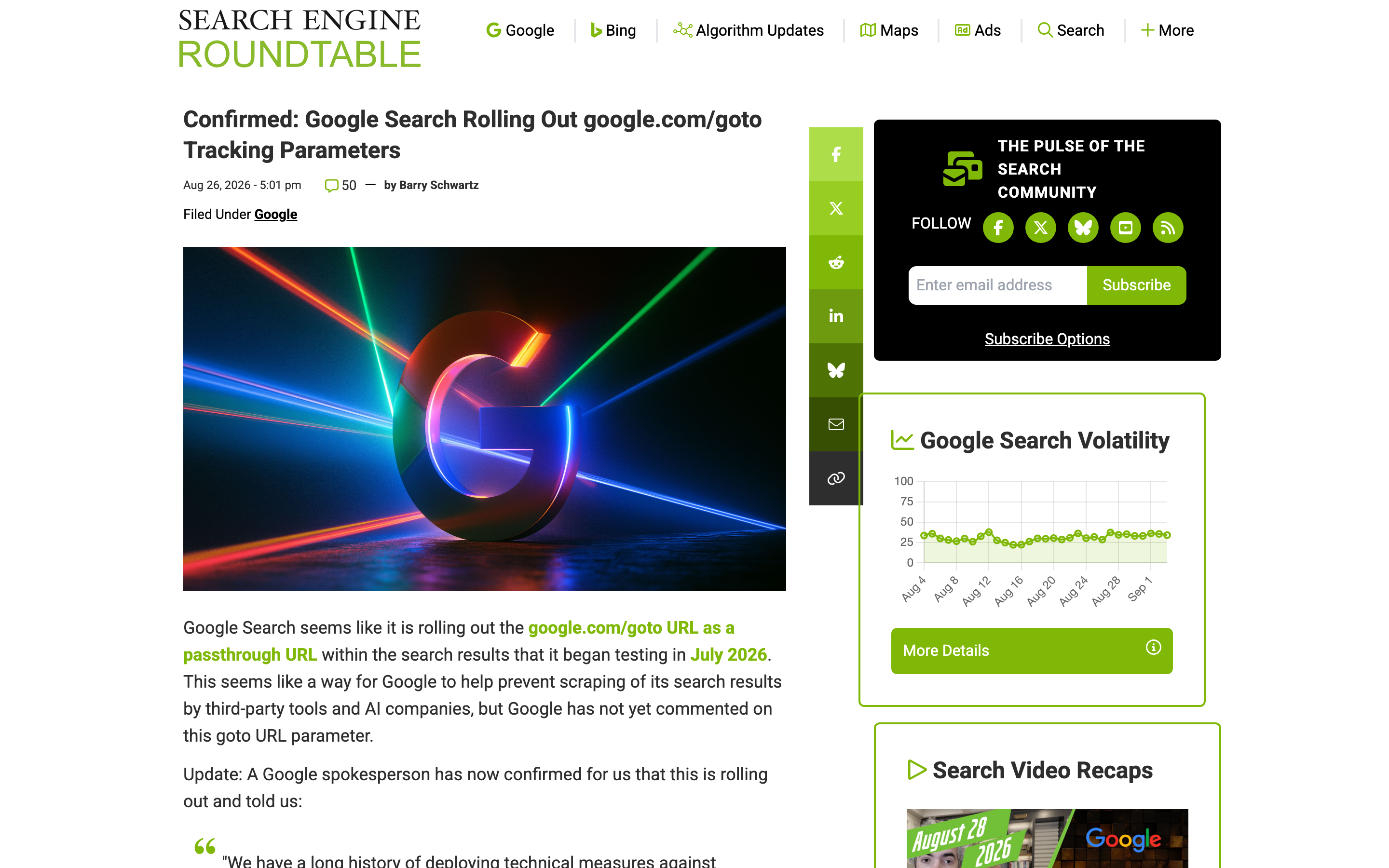
Google used to put the destination address into the result link itself. Many of those links now point at google.com/goto with the real destination encoded inside, and a 302 sends the searcher on to the same page they were always going to. Alex Greenland spotted the first ones on 23 June. Brodie Clark documented the behaviour on 2 July. Google confirmed the rollout on 26 August with a line that says almost nothing: "We have a long history of deploying technical measures against evolving forms of abuse, and we regularly take steps to protect our services and users."
Nothing on your site changes. Canonicals, sitemap, redirects, all untouched. Search Console is untouched too, because it reads Google's own logs rather than the HTML of a results page.
The encoding can't be read locally. A tool that wants the destination has to follow the redirect, one link at a time.
The tools absorbed the cost
Derek Perkins, who runs the rank tracker Nozzle, put the arithmetic at 500 to 1,000 requests to resolve every link in a single five-page ranking. "Each SERP will have hundreds of links to decode," he said on 26 August.
SISTRIX went public with the bill on 31 August. Founder Johannes Beus told the company's newsletter that "every resolved goto address costs an extra server request", that measurement gets "somewhat more complex and more expensive", and that update cycles would "run somewhat slower than usual". He also promised the data itself holds: "the completeness and comparability of its underlying data will not change".
Why your rank tracking data became a moving target
DataForSEO published its numbers on 27 August. For organic results, 99.99% of SERPs came back with direct destination URLs. Then came the breakdown by SERP feature: 52.26% of returned SERPs might carry at least one unresolved goto link inside an AI Overview, 25.1% in the local pack, 0.39% in featured snippets. Read the caveat the company printed alongside them. Those percentages count SERPs holding at least one unresolved link. They don't measure how often Google reaches for goto overall.
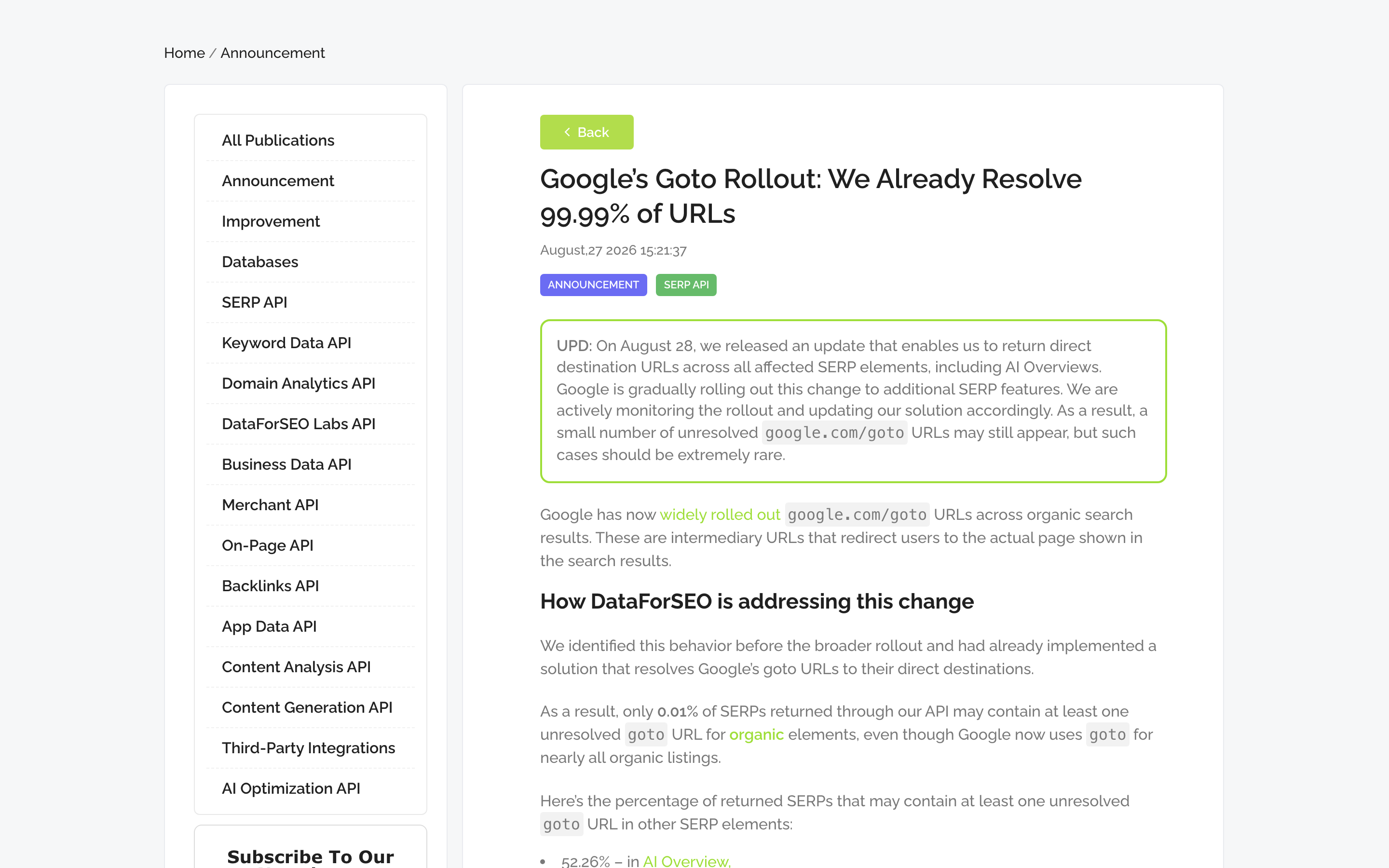
A day later the same page carried an update: the fix now covers all affected SERP elements, AI Overviews included.
So a hole opened in AI Overview citation data and closed roughly 48 hours later, at one vendor, announced on a page you almost certainly don't have bookmarked. Multiply that by every tool in your stack, then ask yourself what a September dip in your visibility score actually measures.
The last time collection got expensive, the caps lasted longer. Google dropped the num=100 parameter on 14 September 2025. AccuRanker capped tracking at the top twenty. SISTRIX stopped updating desktop results pages. Ahrefs had top 100 tracking back by late October and never said how. Those were weeks, and plenty of teams read the resulting drops as ranking losses.
Five things to do this week
- Email your vendor three questions and date the reply. What depth do you collect today, how often does a keyword refresh, and which SERP features are you resolving goto links for. Keep the answer next to your reporting doc.
- Mark 24 to 31 August in your notes as a collection change. When someone asks in November why the line dips there, the answer is written down.
- Check Search Console before you call anything an algorithm update. Position and impressions there come from Google's logs, so the goto rollout couldn't have touched them. If your tracker says you fell and Search Console says you held, believe Search Console.
- Treat AI Overview and local pack citation counts as provisional this month. Report them with the date you pulled them, and pull them again before anyone acts on the number.
- Match a real drop against the confirmed update list first. Most ranking movement never gets a name attached to it, so the question is whether your own pages moved together or one template moved alone.
The wider point about measurement
Every number in a client report has a collection method behind it, and the method is usually invisible until it breaks. Google made SERP scraping expensive in September 2025 and awkward in August 2026. Both times the vendors adapted quietly, and both times the visible symptom was a chart that dipped for reasons no algorithm caused.
The fix is boring and it works. Write down what your tools collect, when they collect it, and what changed. If you track a cluster rather than a flat keyword list, the way you group and refresh those keywords decides how much of this noise reaches your report at all. A tracker that samples the top twenty tells you a different story from one that samples the top hundred, and neither is lying.
Google's own framing is worth keeping in view. The goto link protects Google's results from scrapers. Your ability to measure your own position was collateral, and it will stay that way. Build the parts of your measurement that Google hands you directly, then use third-party rank data for what it's genuinely good at: competitive context, share of voice, and spotting movement you'd otherwise miss.
If you want a measurement setup that still makes sense when the tools change under it, that's the kind of work we do.


