Paid Acquisition
Brand ads look cheap until you count the clicks your organic result would win for free. Run a geo holdout, read the total, and cut what adds nothing.
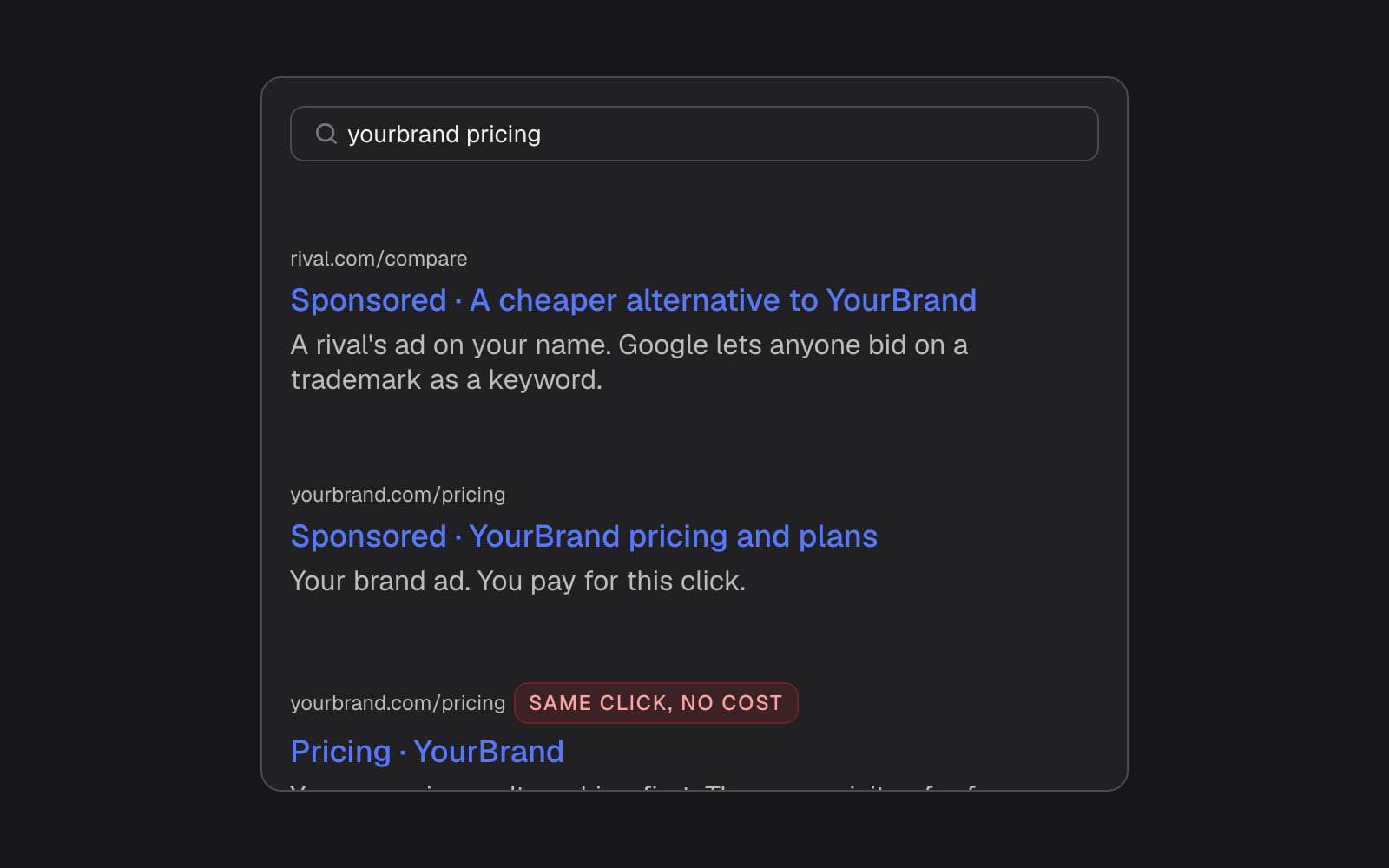
Bid on your own brand name only where the ad wins clicks your organic listing would miss. You find that out with a holdout test: switch brand ads off in part of your market for a few weeks, then compare total brand clicks and signups there against the regions where the ads kept running. Anything short of that is a guess with a budget line attached.
Brand campaigns look like the best thing in any Google Ads account. Cheap clicks, a high click-through rate, a cost per conversion that makes every other campaign look bad. That's the trap. The people typing your name were already on their way, and the ad can claim a conversion the free result under it would have won anyway.
Two well-known studies point in opposite directions, which is why you need your own numbers.
In 2012 eBay switched off its brand keyword ads on Yahoo and Bing and kept them running on Google as a control. In the paper by Blake, Nosko and Tadelis, 99.5% of the click traffic eBay gave up came straight back through organic results. The ads were paying for visits eBay already had.
Google's own meta-analysis of 390 ad pause studies, published the same year, found that when an advertiser's organic result ranks first, 50% of its ad clicks are incremental. The share climbs to 82% when the organic result sits at positions 2 to 4, and to 96% below that. Google adds that the figures measure clicks, without conversions, and that single advertisers vary.
eBay is a household name with nobody worth fearing on its brand query. A B2B SaaS company whose name three competitors bid on lives in a different auction. The test tells you which one is yours.
Start with two reports you already have.
Auction insights at keyword level. Google Ads runs auction insights for single keywords in Search campaigns. Run it on your brand terms. Overlap rate shows how often a competitor's ad appeared when yours did, and position above rate how often theirs sat higher. A rival with a high overlap rate on your name is buying the top of your results page. The report hides advertisers under 10% impression share, so an empty table can still hide a small bidder.
The paid and organic report. With Search Console linked, it shows for each search term whether your ad, your organic result or both appeared, and the clicks each one earned. We use it to find clicks SEO can win. On brand terms it tells you how often you already hold the top organic spot while you pay for the ad above it.
One more fact for the brief. Google's trademark policy lets anyone use your trademark as a keyword. What it restricts, once you file a complaint, is a direct competitor putting your trademark in its ad text. So a rival's ad can show on your name. It can't say your name.
Your brand traffic is three audiences sharing one word. Put each in its own ad group before the test, because each one answers differently.
A geo holdout is the cleanest design. Google's Meridian documentation calls it a go-dark test: spend stops in the test regions, and you measure what the live campaign was adding.
Work out the incremental share: the drop in total brand clicks in the holdout group, divided by the paid clicks you stopped buying there. Scale both groups to the same baseline first, so a seasonal dip doesn't pass for a result.
An illustrative example. The holdout regions bought 1,000 brand clicks a month before the test. With the ads off, organic brand clicks rose by 900 and total brand clicks fell by 100. Incremental share: 10%. If a brand click costs $1.20, each click the ad adds costs $12. Set that next to your non-brand cost per click and decide where the money goes.
Then match the move to what you found:
Whatever the test says, the brand query is worth growing. More people searching your name is the cheapest demand you'll ever have, and the holdout tells you how little of it you need to pay for.
If you want a second pair of eyes on your brand campaign and a holdout plan built around your markets, that's what we do.
Paid Acquisition

Paid Acquisition

Paid Acquisition
One email with what we published that week on SEO, content, conversion, analytics and paid acquisition. Unsubscribe in one click. Privacy notice.