August 2026 spam update: diagnose it one template at a time
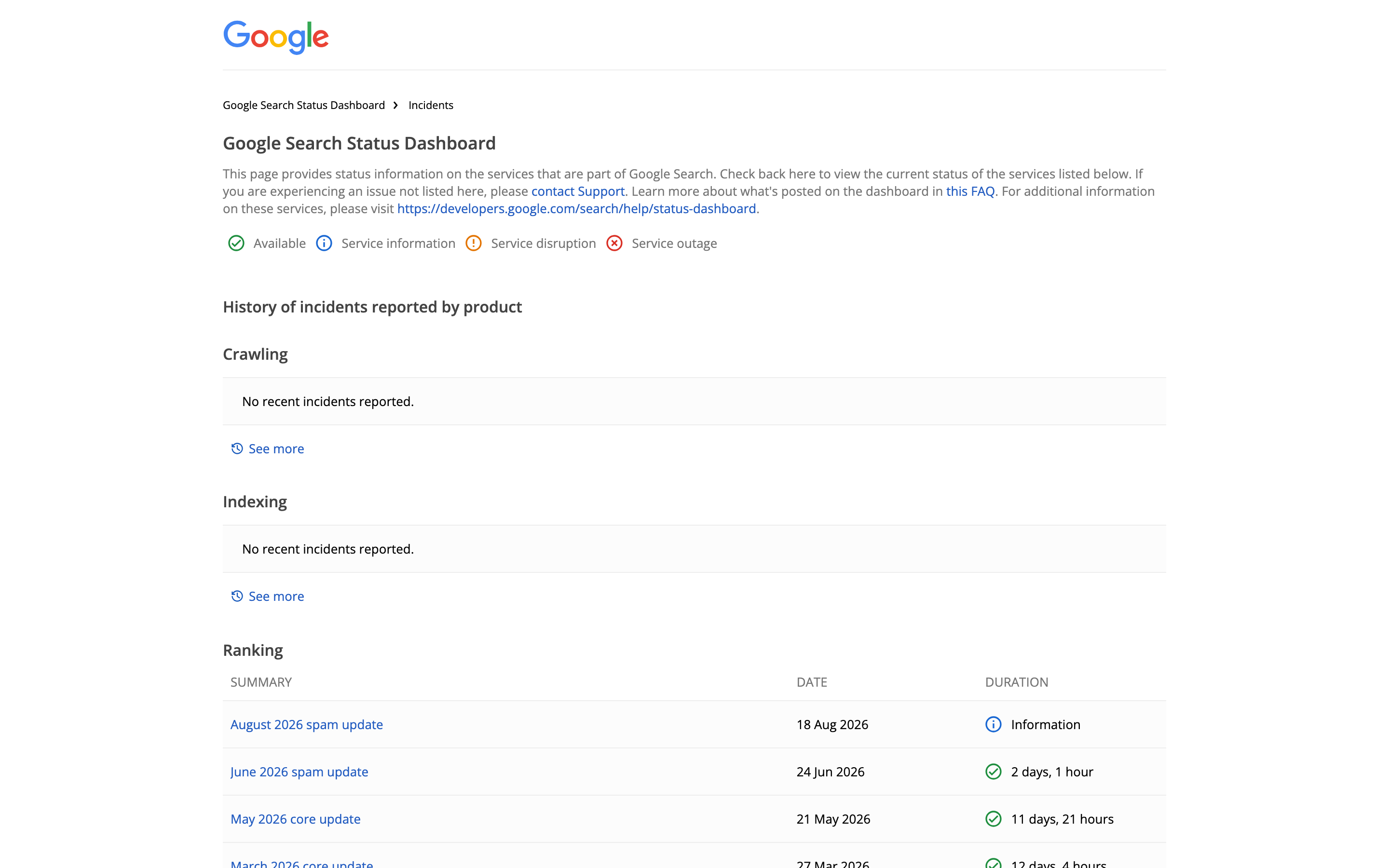
Google's August 2026 spam update started 18 August and is still rolling out. Segment Search Console by directory to find the template that moved.

Google started rolling out the August 2026 spam update on 18 August at 09:27 PDT, and three days later it is still listed as in progress on the Search Status Dashboard. Spam updates measure pages against a published list of sixteen named practices, so the fastest read on your own data is per template. One directory moves while the rest of the site sits still.
That shape is what makes this diagnosable. A core update re-weighs quality signals across the index and shows up as a broad, uneven shift. A spam update matches a pattern, and patterns live in templates.
What Google actually said
The dashboard note is short. The update applies globally and to all languages, and the rollout may take a few days to complete. Search Engine Land logged the release note at 09:28 PDT on 18 August. Google published no blog post alongside it and announced no new policy.
The durations on the same dashboard set the expectation. The March 2026 spam update finished in 19 hours 30 minutes. June took 2 days 1 hour. The May 2026 core update, for scale, ran 11 days 21 hours. Three days in with no end date posted, this is already the slowest spam rollout of the year.
A spam update is a policy check
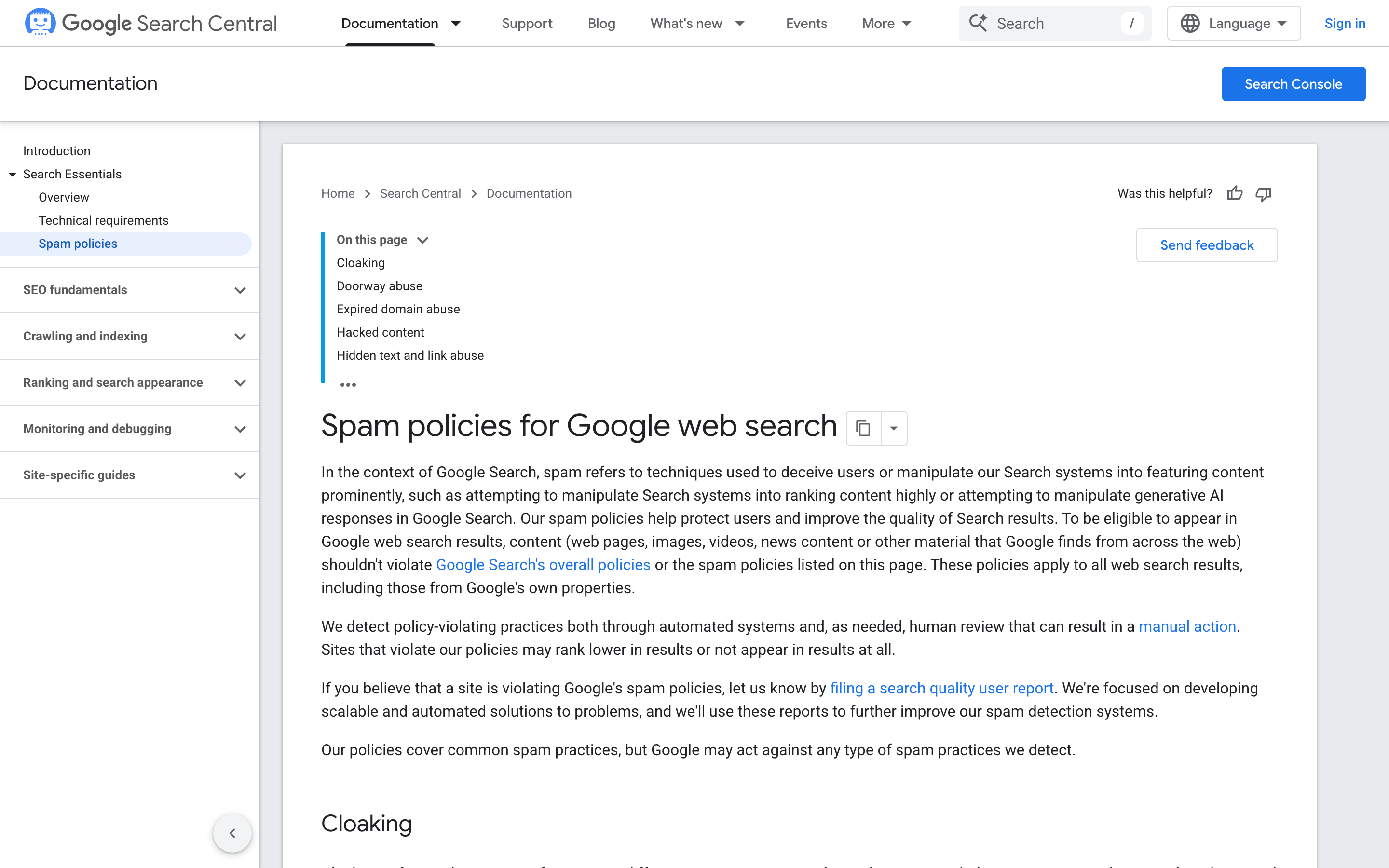
Google’s spam policies page lists what counts: cloaking, doorway abuse, expired domain abuse, hacked content, hidden text and link abuse, keyword stuffing, link spam, machine-generated traffic, malicious practices, misleading functionality, scaled content abuse, scraping, site reputation abuse, sneaky redirects, thin affiliation, user-generated spam. Google is blunt about the consequence: “Sites that violate our policies may rank lower in results or not appear in results at all.”
Most of that list has nothing to do with a B2B or SaaS site. Three carry the risk. Scaled content abuse, which Google defines as pages “generated for the primary purpose of manipulating search rankings and not helping users”, is where an AI-assisted content program lands when it ships volume without a job for each page. Site reputation abuse covers third-party content published on your domain because of that domain’s ranking, which is what a partner blog or a sponsored subfolder can quietly become. Expired domain abuse catches the acquisition that arrived with someone else’s repurposed domain attached.
Volume alone is not the trigger. Zapier runs 134,000 programmatic pages off real integration data and keeps ranking. The line Google draws is whether the page answers something a person came for.
How to diagnose the August 2026 spam update in Search Console
Work per directory. A sitewide total averages away the signal you need.
- Open the Performance report and compare 11-17 August against 18-24 August. Google’s guide to traffic drops asks you to split the data by search type, country, device and page before you conclude anything.
- Export the Pages tab for both windows and group the URLs by first path segment: /blog, /integrations, /compare, /docs. Sum clicks and impressions per group.
- Look for one group down 40% or more while the others hold. That is a template answer, and it names the thing to read next.
- Check when the slide started. A decline that began on 3 or 12 August predates this rollout and belongs to something else.
- Read the sixteen policies against the losing template, ten pages at a time. The pattern shows up fast or it is not there.
Search Console keeps 16 months, so pull the export now and date the file. By February the August comparison window is gone.
What to do while the rollout finishes
Wait for the end date before you judge the size of the move. Google’s core update documentation says it plainly: “Confirm that the core update has finished rolling out. Check the Search Status Dashboard and take note of the start and end date.” The same discipline works for a spam update, and the dashboard is the only place that end date appears.
Hold the sitewide rewrite. Google is clear that recovery runs slow: “it may take months before our systems determine that a site is now producing helpful content.” Rewriting 200 pages this week buys nothing this month, and it wipes out the before-and-after you need to prove which template the update touched. Repair the one that moved, leave the rest alone, and the next update gives you a clean read.
If nothing moved, write down the dates anyway. Google confirms only a fraction of its ranking changes, so a flat week during a named update is a baseline worth keeping.
If you want help turning a Search Console export into a short list of pages worth fixing, that is the kind of work we do.


