AI citation tracking: most citations vanish by the next day
Ahrefs tracked 37,500 AI citations for 20 days: 50-83% vanished overnight and 75% came back. Track a 7-day presence rate per topic cluster instead.

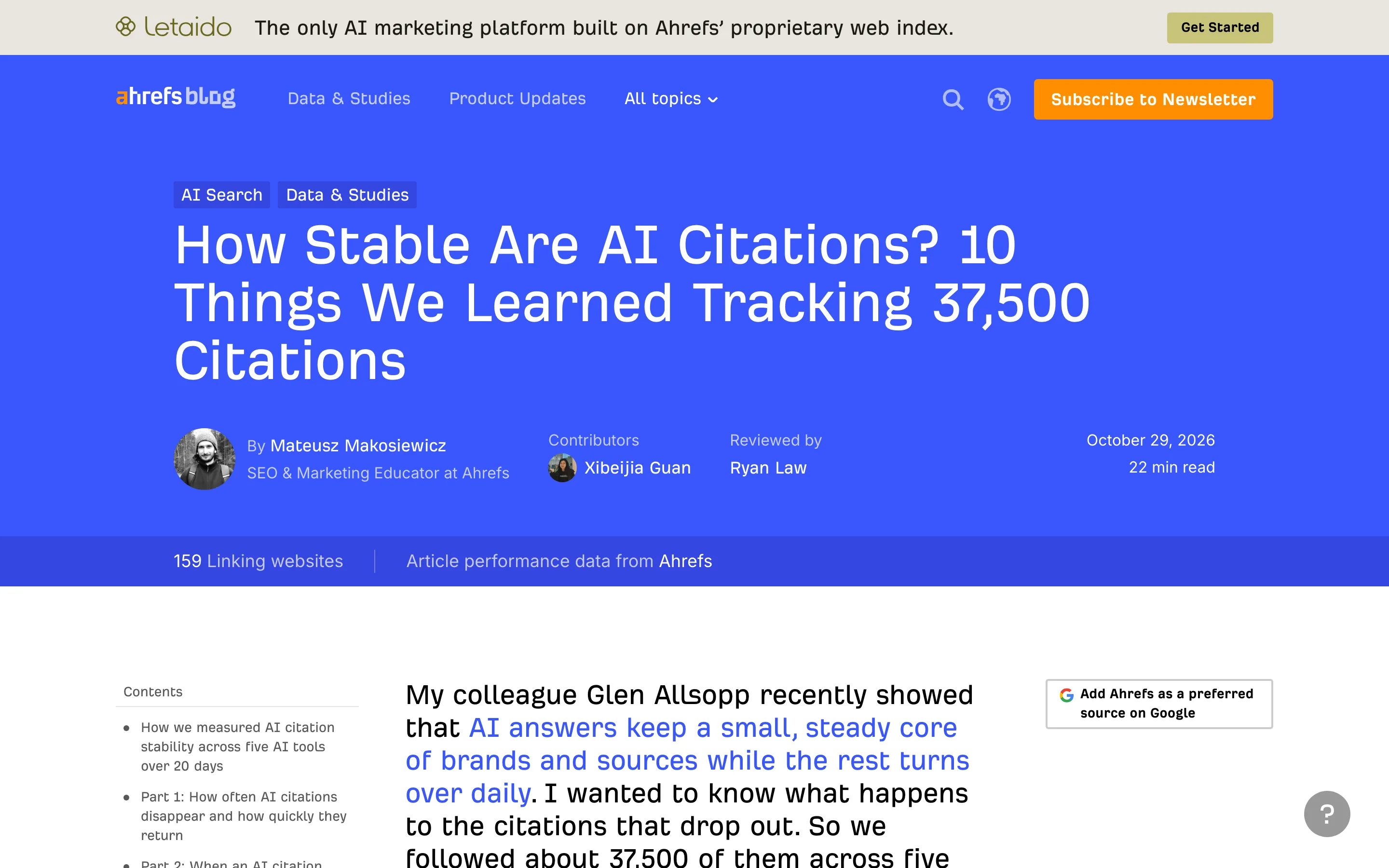
AI citation tracking needs a weekly window, because most AI citations are gone by the next day. Ahrefs followed about 37,500 citations across five AI tools for 20 days and found that 50% to 83% disappeared overnight, while about 75% of the ones that dropped out came back within the 20 days. A daily check per query reports that churn as news. Count how many of the last seven days each page was cited, add it up across the topic cluster, and read that number next to the cluster's Google rankings.
What Ahrefs measured
The study, published by Ahrefs on October 29, 2026 and written by Mateusz Makosiewicz, asked the same questions every day for 20 days and logged which websites each answer cited. Google AI Mode got 1,996 questions and cited 18,009 websites on day one. ChatGPT got 3,173 questions, Google AI Overviews 563, Gemini 1,276 and Copilot 823.
The share of citations gone by day two: 50% on AI Overviews, 58% on AI Mode, 59% on ChatGPT, 81% on Gemini and 83% on Copilot. The share that lasted all 20 days: 6.6% on AI Overviews, 6.8% on AI Mode, 4.0% on ChatGPT. On Gemini and Copilot almost nothing survived a week.
So the same page, for the same question, flickers in and out. On the two Google surfaces, fewer than one citation in five lasted seven days or more.
Why a daily AI citation check misleads you
A drop means different things depending on the run that came before it. Ahrefs found that 34% to 41% of one-day citations never came back. Citations that lasted 8 to 14 days and then dropped out came back 96% to 99% of the time.
Read a daily dashboard and both look identical: cited yesterday, missing today. One is noise that was never yours. The other is a page Google trusts, taking a day off. If you rewrite the second one, you'll credit the rewrite when it returns on its own.
The question type matters too. On "best X" questions, about 75% of cited pages changed every day. Factual questions about a named brand were the steadiest: AI Mode and ChatGPT cited the brand's own site on 100% of them, AI Overviews on 97%. Mix the two kinds in one report and the discovery questions drown out the signal from the brand ones.
How to set up AI citation tracking for a topic cluster
Four steps, built on the query list you already keep for rank tracking.
- Reuse the cluster's query list. The same 20 to 60 queries you tag for rank tracking for a topic cluster, turned into the questions a buyer would type. Split them into three groups: questions about your brand, review and comparison questions, and discovery questions.
- Log daily, read weekly. For every question, record whether a cluster page was cited that day. Each Monday, write down the days cited out of the last seven, a number from 0 to 7. Add those up and you get the cluster's presence score. Ahrefs recommends this seven-day count over single checks.
- Judge a drop by the run before it. A citation that ran eight days or more and then disappeared: wait a week before touching the page. A one-day citation that vanished: ignore it, and don't celebrate the one-day citations either.
- Cross-check with Search Console. Google's generative AI performance report, launched June 3, 2026 and rolled out to every site worldwide by August 31, shows how often your URLs appeared in AI Overviews, AI Mode and Discover's AI features, by page, country and device, from hourly to monthly. Filter it to the cluster's URL folder and read the weekly line.
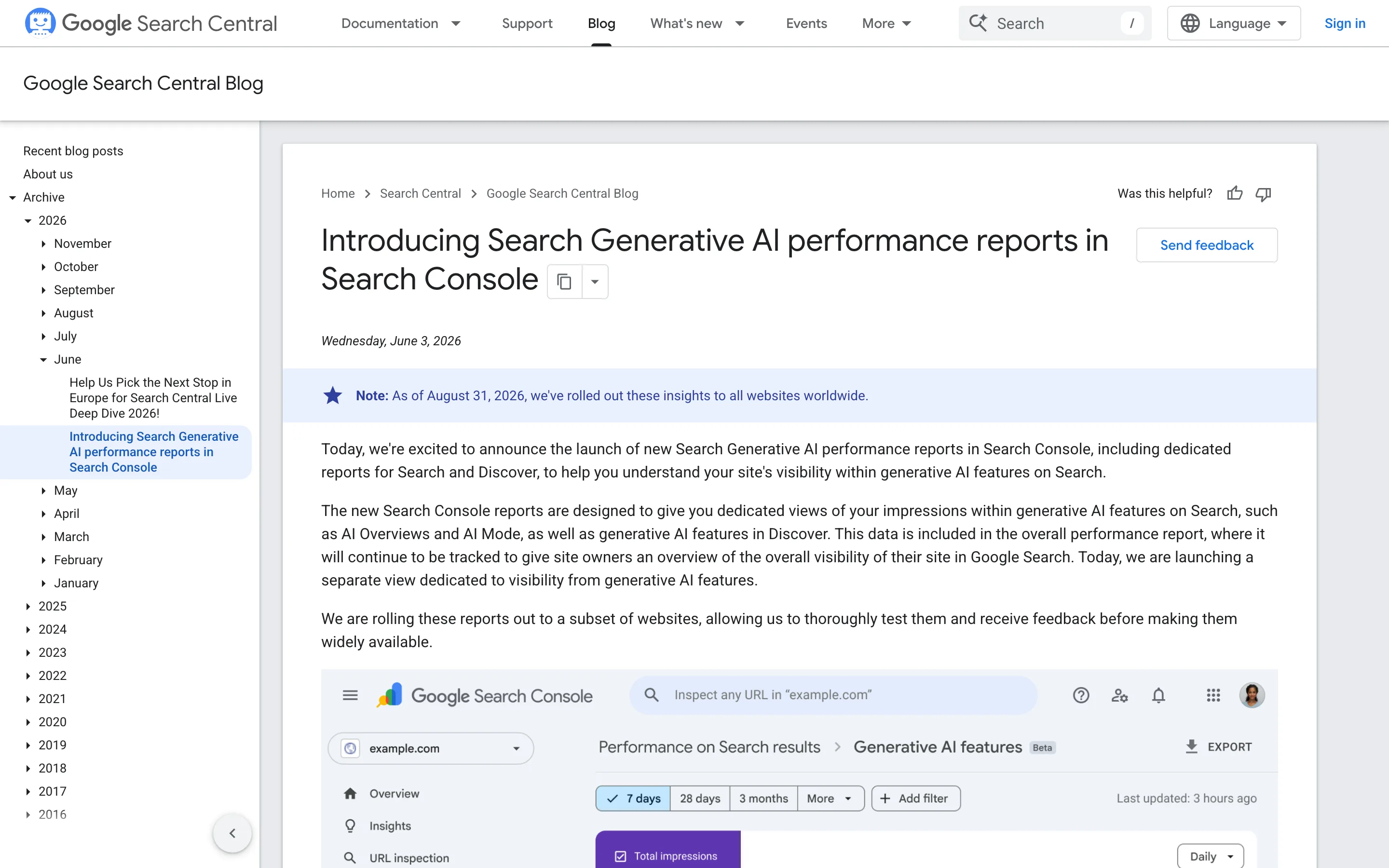
The Search Console report counts impressions only, with no clicks and no position. That makes it a first-party check on your tracker and nothing more. If your logged presence falls and the folder's AI impressions hold, your sample of questions is the problem. Our guide to reading Search Console's AI performance report covers what the impressions count.
Google rankings still predict who keeps the citation
The most useful number in the study is about plain search. On AI Overviews, 29% of pages that ranked in Google stayed cited for seven days or more. For pages that didn't rank, it was 4%. That's seven times the staying power.
Traffic told the same story. Citations that lasted one day came from pages with a median of 8 organic visits a month. Citations that lasted 15 days or more came from pages with a median of 88. Domain Rating barely separated them: both groups sat around 64 to 78.
So when the cluster's presence score falls for a full week, open the rank tracker before you open the page. If the cluster's median position slipped too, the AI drop is downstream of a ranking drop, and that's where the fix is. If rankings held, look at freshness: Ahrefs points to pricing, plan and feature pages, and notes that Google's tools lean on third-party sources for review questions.
What to put in Monday's report
Three lines per cluster. The seven-day presence score, split by question type. The folder's AI impressions in Search Console, week over week. The cluster's median Google position. When all three move together, something changed. When only the presence score moves, wait another week.
If you want help setting up AI citation tracking that your team can read in five minutes on a Monday, that's the kind of work we do at vibhe.


