Google spam update rollouts now finish in under three days
Google's last three spam updates each wrapped in under three days, down from 26. Here's how to reset your before-and-after windows and date a drop right.

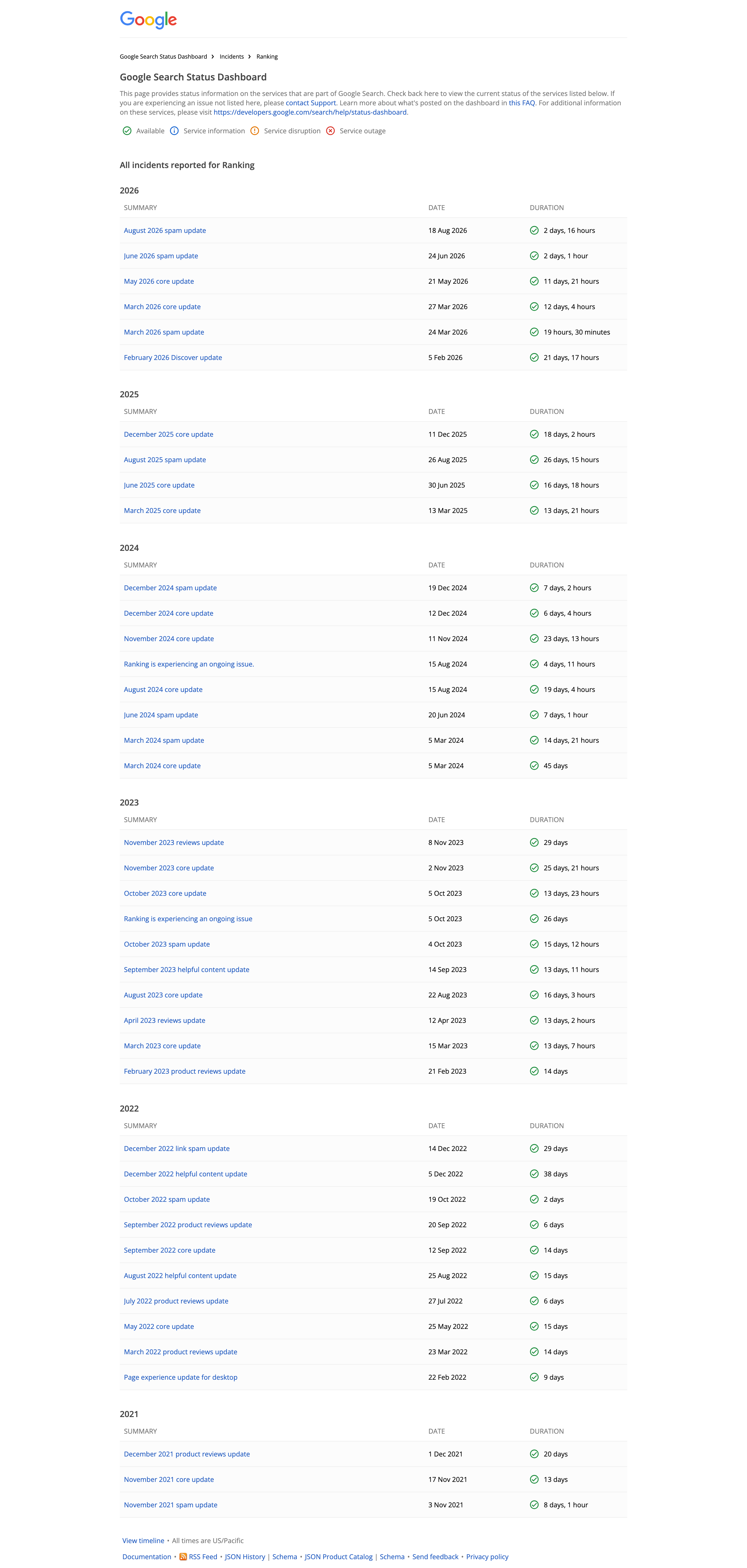
Google's August 2026 spam update started on 18 August and was finished 2 days and 16 hours later. A year earlier, the August 2025 spam update took 26 days and 15 hours. Same kind of update, same dashboard, and a rollout that now closes before most teams have finished arguing about it. If you still freeze the site for a month whenever Google confirms something, you're waiting on a window that shut last week.
The durations come from Google's own Search Status Dashboard, which prints a rollout length next to every confirmed ranking update. All three of 2026's spam updates ran short: 19 hours and 30 minutes in March, 2 days and 1 hour in June, 2 days and 16 hours in August. The three spam updates before them, going back to June 2024, ran 7 days, 7 days, and 26 days.
Google changed its own wording, and that's the tell
Open the incident pages and read the release notes. On 26 August 2025, Google wrote: "Released the August 2025 spam update, which applies globally and to all languages. The rollout may take a few weeks to complete." That one closed on 22 September. On 18 August 2026 the same sentence ends differently: "The rollout may take a few days to complete." June said days too.
Core updates kept their old shape. The May 2026 core update told you up front it "may take up to 2 weeks" and ran 11 days and 21 hours. March's core update ran 12 days and 4 hours. So Google is now running two rollout speeds, and it tells you which one you're in on the morning it starts.
Treat the Google spam update rollout as your diagnostic window
The duration field is the most useful number on that page and almost nobody reads it. It answers three questions at once: which dates are contaminated, when a clean comparison becomes possible, and whether your drop can be pinned on the update at all.
Set the windows off the timestamps, not the headline. August ran 18 August 09:28 to 21 August 01:49, US Pacific. So compare the 14 days ending 17 August against the 14 days starting 22 August in Search Console, and leave the three rollout days out of both sides. Under a core update you'd be sitting on your hands for a fortnight before that second window even existed. Under a spam update you have it by the following Monday.
Most of August moved outside every confirmed window
The short rollout does its real work here. Google confirmed exactly one ranking incident in the whole of August 2026. The third-party trackers, meanwhile, lit up on 1 to 3 August, again around the 5th and 6th, again on the 13th, and again after the spam update closed. Only the 18th to the 21st sits inside a window Google will vouch for. The rest is unattributed.
That matters because "it was the spam update" is the cheapest explanation in the room, and for most of August's movement it was the wrong one. If your rankings turned on 5 August or on 26 August, the spam update wasn't running. You're looking at something Google never named, so the answer has to come out of your own data. We made that case when the unannounced changes started outnumbering the announced ones, in tracking your own volatility baseline.
Four steps for the next drop
- Date the drop before you explain it. Open Search Console, switch to the daily view, and write down the first day the line moved. One date, from your data, before you read a single take.
- Check that date against the dashboard. If it sits outside every confirmed window this year, put the update theory down and keep looking.
- Compare clean windows. Fourteen days before the rollout opened against fourteen days after it closed, with the rollout days excluded from both sides.
- Segment before you conclude. A sitewide average hides which templates actually moved. Splitting by page type is what turns "we lost 12%" into something you can fix, and it's how we worked through this month's spam update.
The freeze is the expensive part
A month-long rollout gave teams a reason to stop shipping. Publish nothing, change nothing, wait for the dust to settle. That cost real ground back when the advice made sense. A spam update now settles in about the time it takes to run one content review, so ship through it, measure after it, and spend the weeks you get back on the volatility Google never confirms. On the evidence of August, that's where most of your movement is coming from anyway.
If you want help turning your Search Console data into a drop diagnosis you can act on, that's the kind of work we do.


